

URL slug: sri-lanka-village-life-kandy-tea-country Meta Description: From bullock carts in Inamaluwa to Kandy’s Temple of the Tooth and the tea hills of Nuwara Eliya — Part 2 of my Sri Lanka photography journey. Category: Long Trip Target keyword: Sri Lanka Kandy Temple of the Tooth tea country
If Part 1 of this Sri Lanka series was about ancient temples and wild elephants, Part 2 is about the textures of everyday life — the rhythms of a farming village, the spiritual weight of a sacred relic, and the terraced green hills where some of the world’s finest tea is still picked by hand. These four days took us from the flat plains around Habarana through the lush mountain roads to Kandy and then up into the tea country, and the contrast between each stop was extraordinary. If you haven’t read it yet, start with Part 1: Ancient Temples, Lion Rock & Wild Elephants.
Day 5: Inamaluwa Village — A Day in the Sri Lankan Countryside
One of the most memorable days of the entire trip began with a short 16 km drive from the Cinnamon Lodge Habarana to the small town of Inamaluwa, located in the Matale District near Sigiriya. This wasn’t a temple visit or a wildlife safari — it was something much more intimate. We were going to spend the day immersed in rural village life.
What followed was one of those perfectly orchestrated experiences that manages to feel authentic at every turn. From the bus, we transferred to bullock carts — slow, creaking, wonderful — which carried us along dusty paths toward a reservoir. From there, we boarded catamarans to cross the water, arriving at a farmhouse where lunch was being prepared over a traditional clay hearth — a low, two-burner wood-fired stove built at counter height that you still find in rural Sri Lankan homes today.
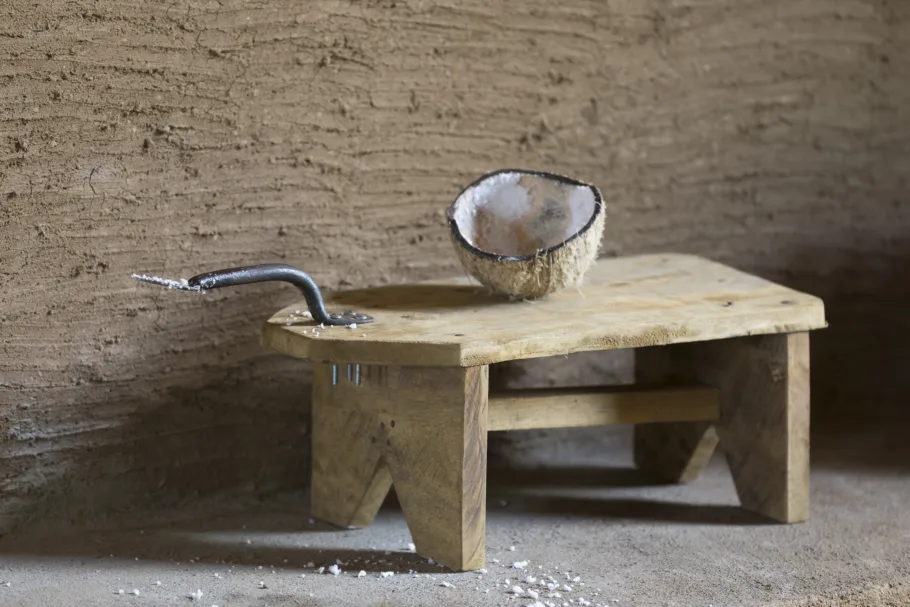
My shot of the coconut scraper sitting on its low wooden stool, half shell resting beside it, fresh shavings scattered across the floor — that’s the kind of still life that tells you everything about how food is prepared here. Nothing wasted, nothing rushed. This simple tool, used to grate fresh coconut for cooking, is still a fixture in rural kitchens across the island.
I watched as women demonstrated the traditional method of husking rice using a vangediya — a stone or wooden mortar — pounding the unhusked grains with a pestle in a coordinated rhythm. Often two people work together, trading blows in perfect sync. Afterward, the rice is winnowed to separate the husk from the grain. It’s a process that has barely changed in centuries, and seeing it up close — the physical effort, the skill, the efficiency of it — was humbling.
The lunch itself was incredible. Fresh, simple, cooked over fire. Everything came from the land around us. After eating, we were driven back to the bus by tractor — a fitting end to a journey that had taken us through three modes of village transportation in a single afternoon. What I appreciated most about this experience is that it’s designed to distribute income across the village — drivers, boatmen, cooks — so that tourism benefits multiple households rather than just one operator. It felt genuinely community-driven.
Day 6: The Long Road to Kandy
Day 6 was a travel day — and a long one. We left Habarana heading south toward Kandy, covering about 54 km to our first stop at the Royal 100 Spice and Herbal Garden, and then another 38 km onward. The drive itself was anything but boring, though. Sri Lanka has a way of filling every kilometer with something worth looking at.

Along the way, I noticed white flags hanging outside homes and along the roadside. In Sri Lanka, white flags are a symbol of mourning and bereavement. They’re displayed immediately following a death and remain up throughout the funeral period — typically a few days to a week. In Buddhist and Hindu traditions, the body is often kept in the ancestral home, and the white flags signal to the community that the household is in mourning. It’s a quiet, dignified tradition, and once you know what they mean, you see them everywhere.
We passed through Matale, where I spotted a couple of fascinating things from the road. The first was evidence of limestone burning — a traditional practice where limestone is heated to around 900°C in kilns to produce quicklime, which is then mixed with water to create a white coating used on buildings. It’s both decorative and functional, and it’s been done this way for generations. The second was kapok trees shedding their cotton-like pods. These towering trees — known locally as Pulun-imbul — can reach up to 70 meters in height, and their seed pods burst open to release a fluffy white fiber used for stuffing pillows and mattresses. From the road, the pods looked like small clouds caught in the branches.
We also caught a distant view of the Golden Temple Dambulla from the road — that massive 30-meter-high (98-foot) seated Golden Buddha built in 2000 at the entrance to the cave temple complex we had explored on Day 1. Seeing it from this new angle, gleaming against the green hills, was a nice bookend to our time in the Cultural Triangle.
In Matale, we paused to admire the Sri Muthumariamman Temple, a Hindu temple dedicated to Mariamman, the goddess of rain and fertility. The current temple dates to 1874, but what really catches your eye is the towering 32.9-meter (108-foot) Gopuram above the main gateway — one of the largest in Sri Lanka — decorated with 1,008 statues of Hindu deities. The statues are the work of South Indian sculptor Nagalingam and his son Ramanathan, along with about 100 designers, painters, and architects from Tamil Nadu and Sri Lanka. The Gopuram was completed in 2007 at a cost of approximately Rs 150 million. What struck me was learning that this temple is used by both Hindus and Buddhists — a reminder of the religious fluidity that characterizes much of Sri Lankan life.

The detail on the Gopuram is extraordinary — every tier is packed with vibrantly painted figures in blues, greens, golds, and pinks. I could have spent an hour just photographing the different levels. It’s the kind of subject where you keep finding new details every time you zoom in.
Along the road, we also passed men harvesting rice by hand with traditional sickles, and fields where the landscape looked almost impossibly green. I kept stopping to shoot from the window — it’s that kind of country.
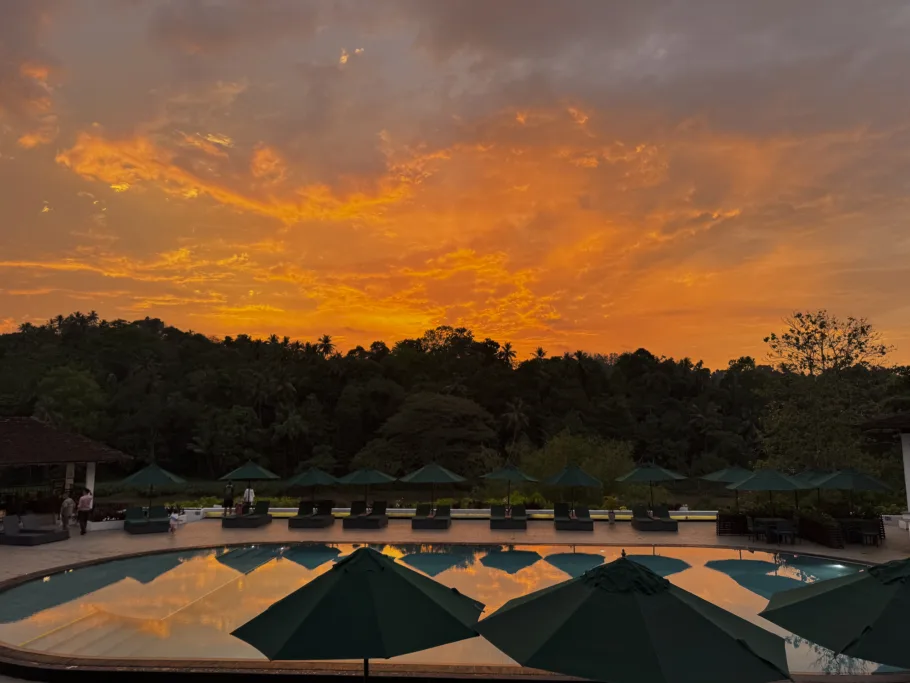
The spice garden visit was entertaining. The owner was incredibly generous — multiple samples of tea, plenty of snacks, all complimentary — and we learned about the spices that grow in this region. It had been a long day on the road, and by the time we arrived at the Cinnamon Citadel in Kandy, we were ready to sit still. The reward was one of the most spectacular sunsets of the trip — the sky over the pool turned deep orange and gold, reflected perfectly in the water below. For info, this one was shot on iPhone.
Day 7: The Vedda People & The Temple of the Sacred Tooth
Day 7 brought a packed itinerary that covered two of the most meaningful stops of the trip.
The Adivasi Jana Uruma Buddhist Center
Our morning started with a drive into the hills to visit the Adivasi Jana Uruma Buddhist Center — a cultural and religious project tied to Sri Lanka’s indigenous Vedda community. The Vedda — or Wanniya-laetto, meaning “forest-beings” — are believed to be the earliest inhabitants of Sri Lanka, with roots dating back to the Neolithic period. Their population today is estimated at roughly 2,500 to 6,600, and they’ve traditionally lived as hunter-gatherers in the island’s forests, using bows and arrows, gathering honey, and sleeping in caves.
The center was created to preserve and promote Vedda cultural traditions while connecting them with Buddhist religious structures. It’s a space of recognition and visibility for a community that has been increasingly marginalized as modernization and displacement have pushed many Vedda into farming or tourism-related work. Meeting members of the community and seeing their cultural artifacts was a sobering and eye-opening experience — a side of Sri Lanka that most visitors never encounter.
Along the way, I spotted what I thought was some kind of exotic flower but turned out to be the male cone of a cycad — likely Cycas circinalis, known as the Queen Sago. The large orangish cone sits at the center of feather-like fronds that radiate in a circular crown, looking like a palm but actually belonging to an ancient plant lineage. Beautiful to photograph, though apparently highly toxic if ingested.
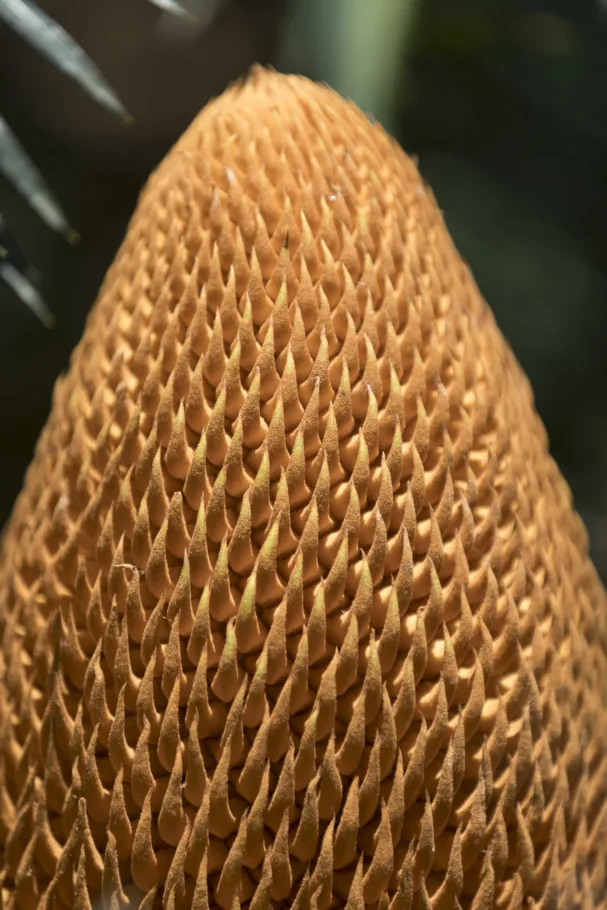
Up close, the geometric pattern of the cone’s scales is mesmerizing — hundreds of tiny pointed tips arranged in perfect spiraling rows. It looks almost like a piece of organic architecture. This is the kind of detail I love to shoot — something most people walk right past, but when you get in tight with the lens, it becomes its own world.
We also stopped at an overlook to view Mahiyanganaya from a distance — a historically significant town best known for the Mahiyangana Raja Maha Vihara temple, believed to be the site of Lord Buddha’s first visit to the island. And along the mountain road, we spotted a waterfall — likely near Diyaluma Falls, which at 220 meters (720 feet) is the second highest waterfall in Sri Lanka. The name means “rapid flow of water” in Sinhalese, and there’s a beautiful local legend about a young chieftain and his betrothed that explains its origin.
The Temple of the Sacred Tooth Relic
The afternoon brought us to one of Sri Lanka’s most sacred sites: the Temple of the Sacred Tooth Relic (Sri Dalada Maligawa) in Kandy. This UNESCO World Heritage Site houses what is believed to be the left canine tooth of Gautama Buddha, kept inside seven nested golden caskets within the former royal palace complex. The temple was built in the 16th century, with the present structure dating to the 17th century, and it remains one of the most important Buddhist pilgrimage sites in the world.

The architecture is stunning — the Kandyan style features incredibly delicate wood carvings, with gold, silver, and ivory inlays throughout. My photograph of the long colonnade of carved wooden pillars really captures the craftsmanship of this place — row after row of intricately decorated columns stretching into the distance, each one slightly different, with warm light filtering through from the side.

Daily rituals called thewawa are performed at dawn, noon, and evening, each involving specific offerings. The morning ceremony (Heel) involves rice offerings, the midday (Dana) is an alms offering, and the evening (Gilanpasa) features herbal drinks, honey, ginger juice, and sweets. On Wednesdays, a symbolic healing bathing ritual called the Nanumura Mangallaya is held. We visited during one of the evening ceremonies, and the atmosphere was deeply moving — the rhythmic chanting, the scent of flowers and incense, the devotion of the hundreds of worshippers who had come to pay their respects.


As a photographer, this was one of those places where you want to be respectful first and a photographer second. I took my time, observed, and tried to capture the feeling of the space rather than just its appearance. The temple at night has a completely different energy than during the day — the warm glow of the oil lamps, the illuminated buildings against the dark sky, the quiet movement of devotees. It reminded me of the evenings I spent at the Shwedagon Pagoda in Myanmar, where the gold of the pagoda becomes almost otherworldly after sunset.
Day 8: War History, a Giant Fig Tree & Tea Country
Our last day in Kandy before heading into the highlands packed in several unexpected highlights.
The Kandy War Cemetery
We started the morning at the Kandy War Cemetery — formerly the Pitakande Military Cemetery — a beautifully maintained Commonwealth War Graves Commission site for soldiers of the British Empire who died during World War II (and one soldier from World War I). The cemetery holds 203 graves: 107 British, 35 East African, 26 Sri Lankan, 23 Indian, 6 Canadian, 3 Italian, 1 French, and 2 unidentified. Of these, 151 were army, 32 air force, 16 navy, and 1 merchant navy.
Most people don’t associate Sri Lanka with World War II, but the island played a significant role. The Imperial Japanese Navy attacked Ceylon on April 5, 1942 — the Easter Sunday Raid — targeting British naval installations in Colombo and Trincomalee. The attack caused significant casualties, sinking the HMS Cornwall and HMS Dorsetshire, and Churchill reportedly considered the threat to Ceylon one of the most dangerous moments of the war. Walking through the rows of immaculately kept headstones, reading names and ages, was a powerful and humbling experience. The cemetery is peaceful, almost serene — a quiet tribute to a chapter of history that deserves to be remembered.
University of Peradeniya & the Giant Ficus
From there, we visited the campus of the University of Peradeniya — the largest university in Sri Lanka, originally established as the University of Ceylon in 1942 and officially opened in 1954 in the presence of Queen Elizabeth II and Prince Philip. It’s the only residential university in Sri Lanka, hosting about 12,000 students across nine faculties. Tuition for local undergraduates is free, while international students pay approximately $1,000 USD per year — an incredible value.
But the real reason to visit is the tree. On the university grounds stands a massive Ficus benjamina (Java Fig) — one of the largest of its species in the world. Its sprawling canopy of aerial roots and branches covers an area of approximately 2,500 square meters. Standing beneath it feels like being inside a living cathedral — the light filters through layers of branches and roots, creating patterns that shift with the wind. I could have spent an hour just photographing this single tree.
Bluefield Tea Factory
The drive from Kandy to the Bluefield Tea Factory in Ramboda was about 56 km and nearly 2 hours, climbing steadily into the central highlands through some of Sri Lanka’s most photogenic terrain. The landscape shifted from tropical lowlands to steep, emerald-green tea terraces clinging to misty hillsides. It’s the kind of drive where you want to stop every few minutes.

Bluefield traces its roots to the 1840s, when forests in Sri Lanka’s central highlands were cleared for tea cultivation under early European planters — part of the rise of Ceylon tea after pioneers like James Taylor introduced it to the island. The estate later passed into local ownership after independence, declined for a period, and was eventually revived by new Sri Lankan management. Today it’s a restored, working plantation producing export-quality teas.
The factory tour was fascinating. At this location, only black tea is produced (green tea is made at a separate facility). All tea types — black, green, and white — come from the same plant, Camellia sinensis, with the differences determined entirely by processing. White tea uses the most tender, unopened buds with minimal handling. Green tea is quickly heated after picking to stop oxidation. Black tea uses more mature leaves that are heavily bruised, rolled, and fully oxidized. We watched the entire process — from withering racks to rolling machines to drying ovens — and tasted several varieties afterward.

One detail that stayed with me: only women pluck the tea leaves, expected to harvest 20 kg over an eight-hour day for roughly 2,000 rupees, with additional compensation if they exceed their quota. Managerial roles are held by men. The labor structure reflects long-standing plantation norms that trace directly back to the colonial era — a reminder that the beauty of a cup of Ceylon tea comes with complex social realities that are worth understanding.

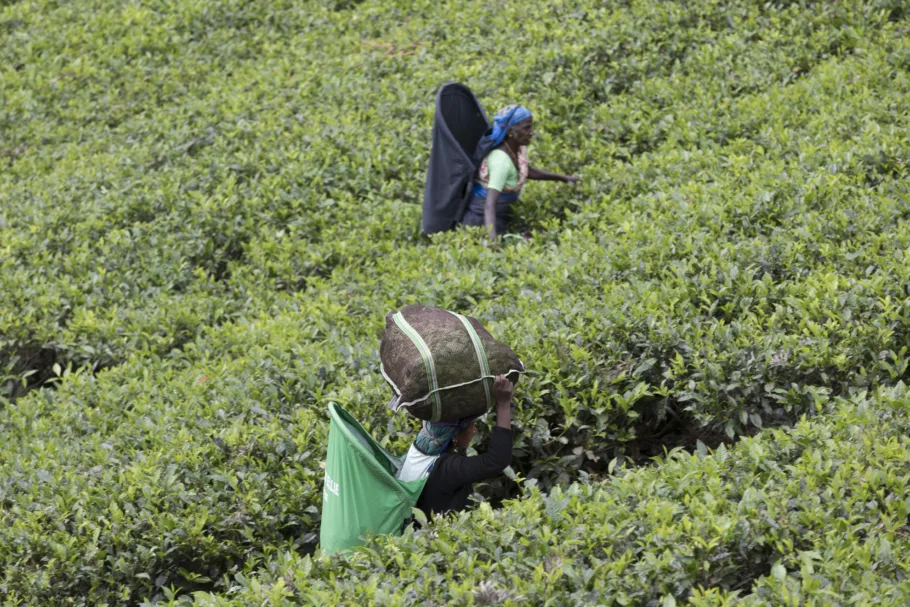
My images of the tea pluckers tell the story better than words can. Watching them move through the steep hillside — deftly selecting only the top two leaves and a bud from each stem, filling their collection bags one handful at a time — you begin to understand the sheer physical labor behind every cup of tea. The scale of the plantation, the isolation of the work, and the practiced speed of their hands make for incredibly compelling photographs.
What’s Coming in Part 3
This is the second post from my Sri Lanka trip. In Part 3, I’ll cover the final leg of our journey — heading deeper into the highlands and down to the coast. Stay tuned.
If you missed it, be sure to check out Part 1: Ancient Temples, Lion Rock & Wild Elephants, covering Dambulla, Sigiriya, and our wild elephant safari at Hurulu Eco Park.
You can also follow along on Instagram at @rvincent for more images from this trip.
Practical Notes for Part 2
- Inamaluwa Village Experience: This is best arranged through your hotel or a local operator. The experience lasts most of the morning and includes lunch. It’s a genuine community-based tourism model — your money goes directly to multiple families in the village. Wear comfortable shoes and be prepared for sun.
- Temple of the Sacred Tooth: Located in central Kandy within the royal palace complex. Dress modestly (shoulders and knees covered, shoes removed). Try to visit during one of the daily ceremonies for the full experience. The temple can be crowded, especially on weekends and Poya days.
- Kandy War Cemetery: Free to visit. A quiet, reflective stop that most tourists skip — worth the detour.
- University of Peradeniya: The campus is open to visitors and the giant Ficus benjamina tree is worth the trip alone. Easily combined with a visit to the nearby Royal Botanical Gardens.
- Bluefield Tea Factory: Located in Ramboda, about 2 hours from Kandy. Tours are available throughout the day and include a tasting session. It’s a working factory, so you’ll see the real production process — not a staged demonstration.
- Driving in the highlands: The roads between Kandy and Nuwara Eliya are steep, winding, and spectacularly scenic. Allow more time than Google Maps suggests and don’t fight it — the views are half the experience.
Internal links: Part 1: Sri Lanka Cultural Triangle, Amazing Burma/Myanmar, Burma/Myanmar — Shwedagon Pagoda Series: Part 2 of 3